

Real estate investment in Budapest in 2026: the complete guide
By Bence Róth · 4 November 2026
Budapest attracts more foreign investors every year. Prices per m², rents by district, returns from real projects, buying costs and taxes: here is what we explain to our clients before their first purchase.
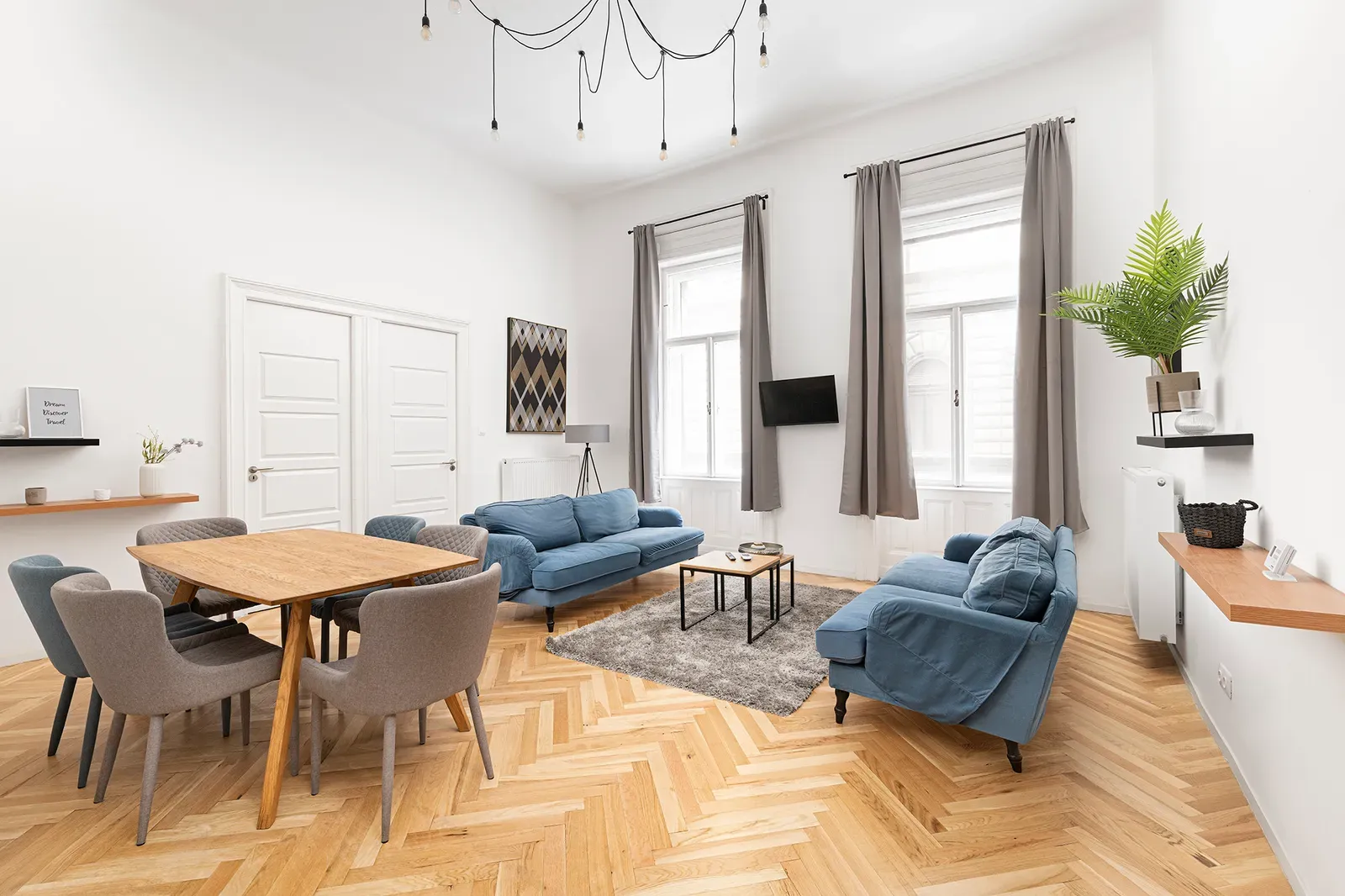
Investing in Budapest means buying in a European Union capital where prices remain well below Western Europe and rental demand is driven by students, expats and young professionals. Our French-Hungarian agency helps foreign owners in Budapest from the property search to rental management. Here, with figures, is what you need to know before you start.
Why invest in Budapest?
Budapest is the economic centre of Hungary. The city is home to international companies, major universities and a skilled workforce. Every year, thousands of foreign students (medicine, engineering, economics) and expats look for a home here: they are the tenants of the central districts.
The city also has an asset few capitals offer at this price: an exceptional heritage. Buda Castle, Parliament and the Danube embankments are UNESCO World Heritage sites, and Budapest remains one of the most visited capitals of Central Europe.
Citizens of the European Union buy on the same terms as Hungarians. Buyers from outside the EU may need an administrative permit, which the lawyer requests for them.
The Budapest property market in 2026
Prices have kept rising. According to the Hungarian Central Statistical Office (KSH), the housing price index was up 8.6% year on year in the first quarter of 2026, and 7.4% for existing homes in Budapest.
- Median asking price in Budapest: around 1.35 million forints per m².
- District V, the most expensive: around 2 million forints per m².
- Rents: +5.2% year on year in Budapest according to the KSH–ingatlan.com index.
Demand is also supported by the Otthon Start programme, launched in September 2025: a 3% fixed-rate loan for Hungarian first-time buyers, which has increased competition for small flats.
What this means for an investor: rents are rising more slowly than prices. Gross yields for long-term rentals in the central districts are generally between 4.5% and 5.5%. Choosing the right property and negotiating the purchase price matter more than ever.
Which district should you choose?
Most of our clients invest in the central districts of Pest, where rental demand is strongest. Here are the median rents of the apartments we have let in each of them.
- District V (Belváros-Lipótváros): median rent of 400,000 Ft a month. The Parliament area, the most prestigious and the most expensive to buy.
- District VI (Terézváros): 280,000 Ft, about 5,000 Ft per m². Andrássy út and the Opera, popular with young professionals and expats.
- District VII (Erzsébetváros): 255,000 Ft. The old Jewish quarter, in high demand from students.
- District VIII (Józsefváros): 300,000 Ft. The Palace Quarter and Corvin, close to the universities: this is where we let the most apartments.
- District IX (Ferencváros): 250,000 Ft. Ráday utca, the Great Market Hall and Corvinus University.
Per square metre, the median rent is around 4,400 to 5,000 Ft a month depending on the district. We advise you street by street: within the same district, two buildings can have very different profiles.
How much does an apartment earn? Four real projects
Rather than averages, here are investments made with Story's in Budapest. The income is net: after costs, management fees and Hungarian taxes, at the time of the project.
- 29 m² studio, Rákóczi tér, fully renovated and furnished: €115,000 invested, €4,600 net income a year.
- 57 m² one-bedroom, Kálvin tér: €165,000 invested, €6,200 net a year.
- 74 m² one-bedroom, Horánszky utca: €172,000 invested, €7,200 net a year.
- 145 m² five-bedroom, Bérkocsis utca: €321,000 invested, €17,400 net a year.
These examples show a simple rule: a well-managed renovation and a property suited to demand (students sharing, young professionals) make more difference than the district alone. You can test your own figures with our yield simulator.
Buying costs
In Hungary, buying costs are low compared with most of Western Europe.
- Transfer duty: 4% of the price, paid by the buyer (2% on the part above one billion forints).
- Lawyer: required for the sale and the land registry entry, usually around 1% of the price plus VAT.
- Renovation and furniture: depend on the condition of the property. We price them before you buy, with a fixed budget and schedule.
Taxes on rental income
For individuals, Hungarian rental income is taxed in Hungary at a flat rate of 15%. Two options:
- a flat 10% allowance for costs;
- or deducting actual costs with receipts (works, fees, insurance…).
Depending on your situation, a social contribution may be added: our partner accountant checks it for you. In your country of residence, the tax treaty with Hungary applies; ask your tax adviser.
You can also hold the property through a Hungarian company: corporate tax is 9%, one of the lowest in the European Union, plus a local business tax of up to 2%. Dividends paid to individuals are taxed at 15%, subject to tax treaties.
Long-term letting or Airbnb?
For long-term rentals, there is no rent control in Hungary: the owner sets the rent freely, and the lease is agreed under the Civil Code.
Short-term letting, on the other hand, is increasingly restricted. It has been banned in District VI since 1 January 2026, no new registrations are accepted anywhere in Budapest until 31 December 2026, and District VII has adopted its own restrictions. This is why we build our projects on long-term letting, which is more stable and easier to manage from abroad.
Investing from abroad: the steps
With Story's, one team takes you from start to finish:
- Project analysis: options presented with a detailed analysis, tailored to your budget.
- Search brief: your criteria and the signature of the search mandate.
- Search and viewings: on site, in person or by video.
- Signing: offer, sale contract and land registry entry with an independent Hungarian lawyer.
- Renovation and furnishing: with our network of craftsmen, on a fixed budget and schedule.
- Rental management: finding the tenant, the lease, collecting rent, maintenance and a monthly report.
Do you have a project? Tell us about it: an adviser will look at your budget and suggest suitable properties.
Frequently asked questions
Can a foreigner buy an apartment in Budapest?
What yield can I expect from an apartment in Budapest?
What are the buying costs in Hungary?
How is rental income taxed?
Can I rent on Airbnb in Budapest?
Own an apartment in Budapest?
Tell us about it. We reply within one working day with a rent estimate and our management terms.